
What is music metadata?
Whether you’re asking a streaming platform for new music recommendations or searching for your favorite artists, metadata is always at work behind the scenes, giving structure to the bottomless global library of digital music.
In a streaming-first environment, metadata is the foundation of your music. It defines everything from essential details like release title and artist name to more subjective information like mood and comparable artists.
But at its core, music metadata is the structured and actionable information attached to your recordings and compositions. Distributors use it to deliver your music to streaming platforms. Digital service providers rely on it to organize catalogs and power recommendation algorithms. And rights organizations depend on it to track music usage and pay royalties accurately.
In this blog, you’ll learn more about the different types of metadata, the benefits of providing this information, and how to optimize your data to manage your music effectively.
What are the types of music metadata?
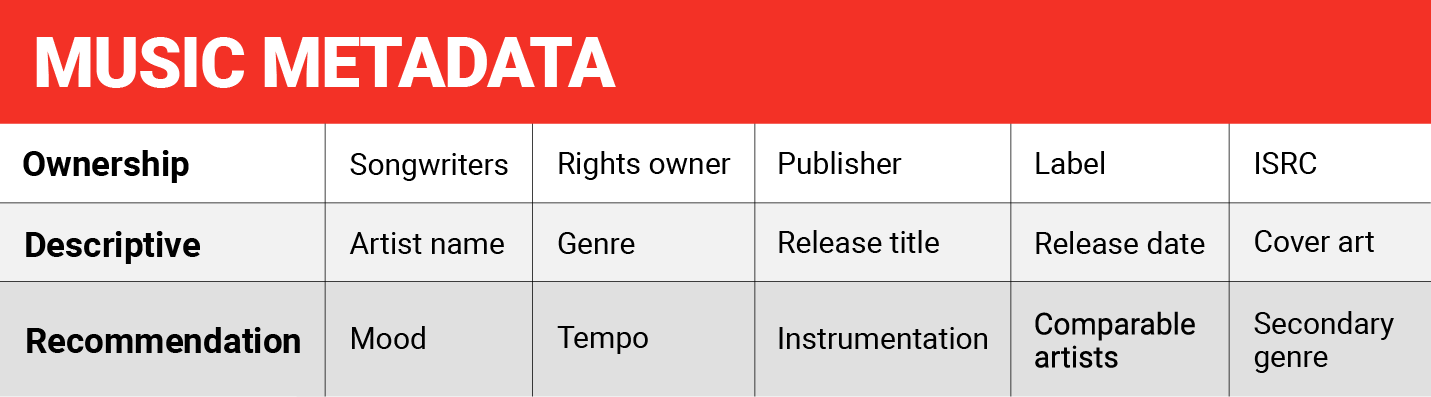
There are three main categories of metadata: ownership (or rights) data, descriptive data, and recommendation data.
- Ownership metadata helps ensure payment and rights protection.
- Descriptive metadata supports catalog organization.
- Recommendation metadata fuels algorithmic discovery.
The chart below provides some key examples of metadata in each category.
Why does music metadata matter and how is it used?
If you examine the chart above, you’ll notice metadata truly encompasses your entire release, making it indexable and trackable across platforms.
Now let’s take a closer look at the benefits of metadata and how it’s used.
Get paid accurately and on time
Your metadata contains information such as songwriting splits and publishing rights, which DSPs, distributors, and publishers rely on for royalty payments.
Before submitting your music, always finalize your songwriter splits and review your copyright information to ensure any contributors are paid accordingly.
Metadata becomes especially important if you register your music with a performing rights organization or collections societies. These partners depend on matching metadata to process royalties accurately.
Avoid rejection from DSPs
Streaming platforms rely on metadata to process your music accurately, route royalty payments, and optimize the fan experience. Platforms keep metadata accurate by maintaining certain standards and requirements for music uploads, which distributors (and thereby artists) need to follow.
If you’re planning to release music, choose a major-platform-preferred distributor like CD Baby to ensure your music meets requirements for distribution.
Power personalized discovery
You can make it easy for fans to find your music and for algorithms to recommend it, by providing data around genre or arrangement. This data can help algorithms relate your music to other artists’ music and fine tune its discovery tracks for fans. Platforms are always advancing their recommendation capabilities through new tools as well as powerful integrations.
Land more placements
Detailed metadata can increase your chances of being considered for placements in mixed media (sync licensing) as well as Spotify playlists. Both opportunities can factor in “recommendation” metadata such as mood, tempo, and arrangement to assess how your song might fit the playlist or media.
What are some metadata best practices?
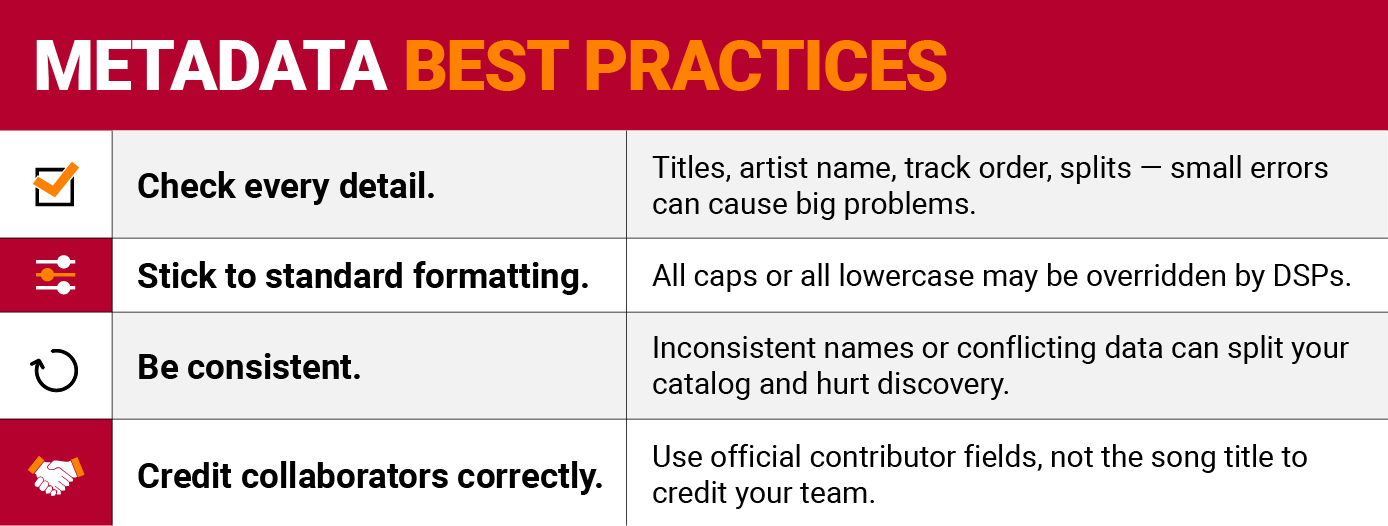
Keeping your metadata clean and consistent sets your music up for success from submission to release day and beyond. Follow these best practices to optimize your metadata.
Accuracy
Double-check your submission to be sure you’ve correctly entered subjective information like song and release titles, your artist name, track order, and more. Distributors will only review your metadata to ensure it meets objective platform requirements.
Capitalization
Follow capitalization practices (of Chicago Style for English Language) for release titles to avoid problems with formatting on digital streaming platforms. Using non-standard formatting, such as all-capitalization or all-lowercase, may cause issues or DSP overrides.
Consistency
Make your music searchable (and accurately sorted by algorithms) by keeping metadata consistent across platforms and uploads. Changing your artist name or releasing music with incomplete or contradictory metadata can fracture your catalog.
Features
Follow your distributor’s submission flow to enter contributors and roles in dedicated form fields. From there, individual platforms will choose to display the info in the track or album titles based on their internal guidelines. Do not include contributors in parenthesis within your release titles.
How do I provide metadata for my music?
Your distributor will ask you to provide all the right metadata during your music submission process.
CD Baby has been collecting robust metadata from our artists for over 25 years and is a preferred distribution partner of major platforms like Spotify and Apple Music. When you distribute your music with CD Baby, you’re following guidelines we’ve worked closely with leading digital streaming platforms to develop and enforce to help you protect your music, build your fanbase, and get paid.
Ready to distribute your music with accurate, industry-standard metadata? CD Baby offers distribution to over 150 streaming platforms worldwide at affordable pay-per-release rates. Create a free account today and release your music on time.