

If you’ve released music to streaming platforms through a distributor like CD Baby, you probably know you get paid for your streams in the form of recording royalties. But did you know that those same streams are generating additional royalties that you might be missing? Many independent artists don’t take the simple steps needed to claim these royalties, leaving money on the table.
In this blog, you’ll learn the six main types of music royalties, how each of them works, and how to collect them to boost your earnings.
What are music royalties?
Music royalties are payments owed to rights holders when their music is used or reproduced under license. Different uses generate different types of royalties — and because every song carries two separate copyrights (the recording and the composition), even a single use can generate multiple royalties at once.
The two forms of music copyright: recordings and compositions
The music industry’s royalty structure is built on music copyright — the legal right to copy, distribute, perform, and monetize a piece of music.
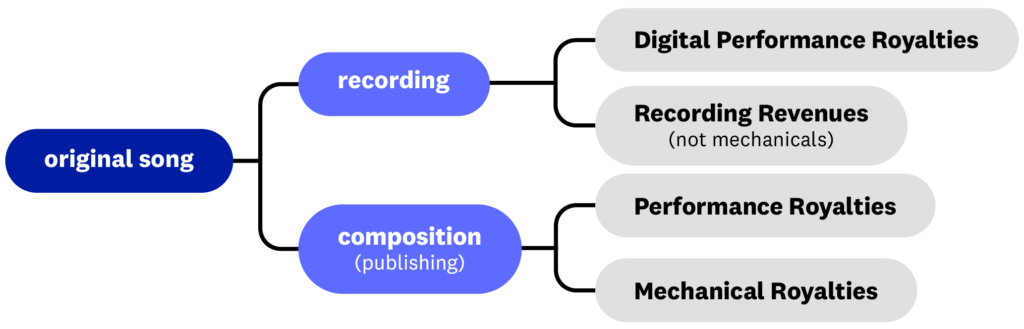
There are two forms of copyright inherent in every song. Uses of each copyright generate corresponding royalties.
- Recording: the particular recording of the song
- Composition: the underlying music and lyrics
The chart below shows how royalties flow from the two forms of music copyright. Uses of the sound recording can generate recording royalties and digital performance royalties — paid to artists, labels, and other owners of the sound recording. Uses of the composition generate performance royalties and mechanical royalties — paid to songwriters, composers, lyricists, and/or publishers.
If you’re an independent artist writing and recording your own music, you probably own both the recording and composition rights on your releases — entitling you to royalties generated from both. In this next section, we’ll look at each type of royalty that stems from the recording and composition of a song.
The six main types of music royalties
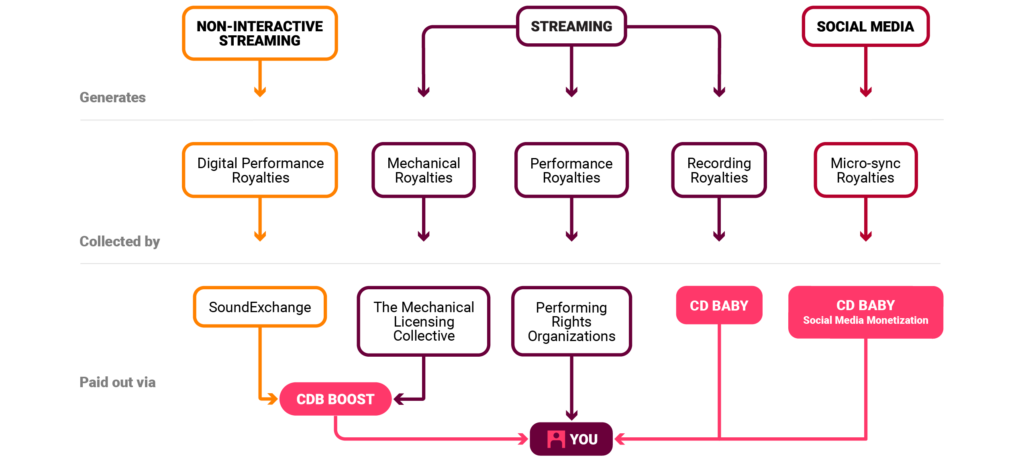
The chart below gives you a preview of only the most common royalties independent artists receive after distributing their music to platforms like Spotify and Apple Music, social video platforms like TikTok and YouTube, and non-interactive streaming platforms like Pandora and SiriusXM.
As you’ll see, there are even more ways to generate royalties through live performances, sync licensing deals, radio play, and more. But we’ll start with the basics.
1. Recording Royalties
What they are: Recording royalties arise from the use or digital reproduction of the sound recording of music. That includes streams, digital downloads, physical sales of your music, and more.
Paid to: The owner of the sound recording — typically the recording artist and/or their label.
If you distribute your music with CD Baby, you retain full ownership of your sound recordings and receive 91% of your recording royalties from streaming activity on platforms like Spotify and Apple Music. CD Baby takes a 9% share, aligning our success with yours.
How to collect recording royalties: Your distributor automatically pays you recording royalties for your streaming activity. Sign up for a free CD Baby account today to distribute your music and start earning from your streams.
2. Mechanical Royalties
What they are: Mechanical royalties are generated whenever a composition is reproduced, digitally or physically. These royalties apply to interactive streams on platforms like Spotify and Apple Music, digital downloads, physical sales, and more.
Paid to: Songwriters, composers, lyricists, and/or publishers. If you own both a song’s recording and composition rights, then mechanicals are simply one more royalty type you can collect from your work. If you own a song’s composition and someone else records and releases a cover of it — on vinyl, streaming, anywhere — you’re owed royalties for their use of it.
How to collect mechanical royalties: If you’re a CD Baby artist, you can claim mechanical royalties on your music by adding CDB Boost to your releases. CDB Boost registers your music with The Mechanical Licensing Collective (The MLC), which is the main non-profit organization in the U.S. for helping songwriters collect mechanical royalties.
3. Performance Royalties
What they are: Performance royalties are earned when a composition is played or performed publicly. That can mean radio airplay, live performances, background music in public spaces, streaming on interactive platforms, and television broadcasts.
Paid to: Songwriters, composers, lyricists, and/or publishers.
How to collect performance royalties: If you’re based in the United States, register your music with a performing rights organization (PRO) like ASCAP, BMI, or SESAC to start collecting performance royalties. For artists outside the U.S., your country has its own PRO.
|
4. Neighboring Rights Royalties
What they are: Neighboring rights royalties compensate recording artists and sound recording owners when a song is played publicly. They’re called “neighboring” rights because they sit alongside performance royalties, but compensate rights holders for the use of a sound recording instead of the composition.
Here’s where it gets a bit messy. Strictly speaking, neighboring rights don’t exist in the United States. U.S. law only requires terrestrial radio stations (AM/FM) to pay performance royalties on uses of the composition — not the recording. The U.S. has a partial equivalent in Digital Performance Royalties to cover spins on non-interactive streaming platforms like Pandora, SiriusXM, and iHeart Radio, but more on that in the next section.
Paid to: Performing artists and/or owners of the master recordings (often an independent artist or a label).
How to collect neighboring rights royalties: If your music is getting international play, register directly with SoundExchange and opt into their foreign mandate to collect international neighboring rights (including terrestrial radio play outside the U.S.). SoundExchange can collect these royalties for you through reciprocal agreements with foreign Collective Management Organizations (CMOs), but note that coverage varies by territory.
5. Digital Performance Royalties
What they are: Although the U.S. does not have neighboring rights, digital performance royalties are a partial equivalent for rights holders. These royalties cover uses of the sound recording on non-interactive streaming platforms like Pandora, SiriusXM, and iHeartRadio.
Outside the U.S., where artists and rights holders do earn from traditional radio play, royalties from non-interactive stations are considered just another royalty source under the neighboring rights umbrella.
Paid to: featured recording artists, non-featured session musicians, and the owners of the sound recording copyright
How to collect digital performance royalties: The U.S. government designated SoundExchange as the official sole entity responsible for collecting and distributing digital performance royalties to performing artists and owners of the sound recording. Payouts from SoundExchange are divided by law: 50% goes to the sound recording copyright owner (an artist or record label), 45% to the featured artist, and 5% to a fund for non-featured session musicians.
If you’re a CD Baby artist, you can claim your digital performance royalties by adding CDB Boost to your release. CDB Boost registers your music with SoundExchange’s domestic services and helps you easily collect digital performance royalties.
6. Sync (and micro-sync) Royalties
What they are: Sync royalties are generated when your music is synchronized with visual media. That can entail individual licensing deals for using music in films, television, and video games or blanket licensing agreements for use of music on social video platforms like TikTok or Instagram.
Paid to: Sync royalties are split between songwriters and publishers (for the composition share) and artists/record labels (for the sound recording share).
How to collect sync royalties: You can collect micro-sync royalties using CD Baby’s Social Video Monetization service. Separately, you can make your music eligible for sync licensing deals by registering with CDB Boost.
The music royalty checklist for independent artists
Now that you understand the core music royalty types, here are next steps to collect them:
- Release your music with CD Baby and automatically receive recording royalties from interactive streaming and downloads.
- Register with a PRO (ASCAP, BMI, SESAC, or your country’s PRO) to collect performance royalties from radio, television, shows, and streaming.
- Add CDB Boost to your release to collect mechanical royalties from interactive streaming in the U.S. via The Mechanical Licensing Collective and digital performance royalties from non-interactive streaming via SoundExchange (neighboring rights royalties for artists outside the U.S).
- Opt into CD Baby’s Social Video Monetization service to collect micro-sync royalties from user-generated content on YouTube, TikTok, Facebook, and Instagram.